The awkward bedroom I keep thinking about is a 3.2 m × 3.8 m back room in a Victorian terrace in Walthamstow: one sash window over the radiator, a 60 cm deep chimney breast, and a UK king-size mattress, 150 cm × 200 cm, leaving 55 cm to shuffle round one side. At 8:15, during the school-run rush, the ceiling pendant made the whole room look awake and unforgiving. By 10:30 at night, the bedside lamp made the wardrobe end vanish. My thesis is blunt: a bedroom with fewer than three controllable lighting layers will feel either clinical or gloomy, however expensive the shade is.
What we're working with
Bedroom lighting layers have to respect the furniture first. The bed usually claims the longest usable wall, then the wardrobe doors demand 60 cm to swing or slide, and the door itself often opens onto the only sensible switch position. In many UK homes the BS 1363 socket is in the wrong place: behind a divan, on the chimney breast, or just low enough to make a plug-in wall light look like a student bedsit workaround. A radiator under the window rules out floor lamps with fabric shades sitting too close to heat, and blackout curtains swallow more light than people expect. The TV cable run, if there is one, tends to drag the eye towards the foot of the bed, which is rarely where you want the softest light. Aim for roughly 100-150 lumens per square metre for general use, 400-500 lumens per reading position, and a dim ambient layer low enough to let your brain believe bedtime is actually happening.
Layout 1: Overhead centred on the walking space, reading lights tight to the bed
The usual mistake is centring the pendant on the whole ceiling because the rose is already there. In a small double room, that often puts the bulb over your face. Shift the fitting, if you can rewire, towards the circulation strip between bed foot and wardrobe. If you cannot, use a shallow drum shade with a diffuser so the lamp does not glare when you're lying down.
Reading light wants to be boringly accurate. A 4.5W LED bulb at 400 lumens is enough for a paperback without lighting the whole room like a dental surgery. Put the switch where a hand falls naturally, about 70 cm above the mattress top if it is wall-mounted, or on a bedside table 50-60 cm high. The trade-off is symmetry: chimney-breast alcoves rarely match, so one lamp may sit 10 cm further out. Sorted beats symmetrical if both people can read without squinting.
Layout 2: Ambient light along the wardrobe wall in a 1930s semi
A 1930s semi often has better proportions than a terrace bedroom, but the wardrobe wall can become a black slab after dusk. A low ambient layer fixes that without adding another object to trip over. Put the strip on top of the wardrobes, set back 5-8 cm from the front edge, so the light washes the ceiling rather than drawing a bright line across the doors.
Keep it warm. In bedrooms, 2,200K to 2,700K is the sweet spot; 4,000K may be useful in a utility room, but it makes bedding look a bit hospital. Cheap LED tape can show dotted reflections on gloss doors, and some adhesive backing gives up after a hot summer. A proper aluminium channel costs about £14.99 per metre and reduces that speckled look. It is a small faff at fitting stage, but it stops the room feeling like a gaming desk.
Layout 3: The rented flat with no rewiring and one mean pendant
The counterargument is fair: one smart bulb in the ceiling can dim, warm up, turn blue if you insist, and cost £12.99. Why bother with layers? Because a single source still throws a single shadow. Dim it to 20% and you have a gloomy room with the same overhead direction; warm it to 2,200K and your wardrobe is still a cave.
Renters need a no-drama version. Use the pendant as the cleaning and getting-dressed layer, then add plug-in wall lights with opaque shades. Cable clips are not glamorous, but white 6 mm clips on a white wall look decent if you run them straight down to the skirting. Smart bulbs help most when grouped: a ceiling bulb at 40%, bedside bulbs at 25%, dresser lamp at 15%. The caveat is real: if someone turns the wall switch off, many smart bulbs lose their routine until power comes back.
Layout 4: New-build bedroom with en-suite glare and too many downlights
New-build bedrooms often suffer from the opposite problem: six downlights in a tidy grid, all bright, all overhead. It looks crisp on a viewing day and harsh on a wet Tuesday. If you are planning before plasterboard, set downlights 60-75 cm from the walls and avoid the strip directly above pillows. You want light on wardrobe fronts and floor edges, not on closed eyelids.
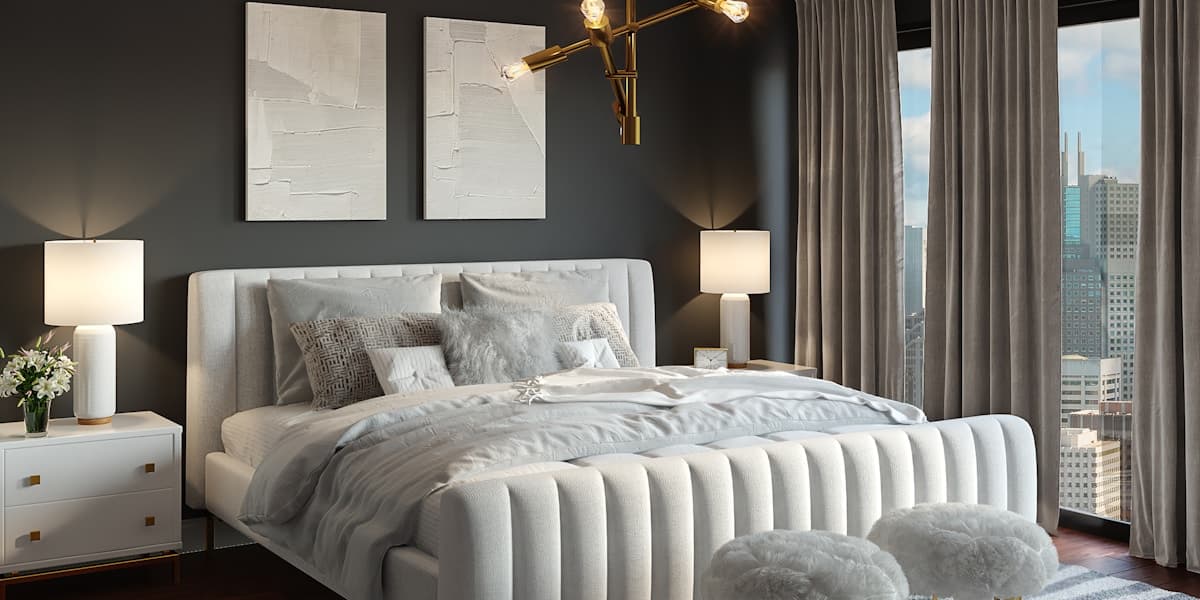
Bedside pendants work well here because they free the table surface for the ordinary mess of life: phone, book, water, a receipt you meant to bin before council recycling collections. Hang each pendant 35-45 cm above the bedside top, with the bulb shielded from the bed. Dimmer compatibility matters. Some low-load dimmers buzz with LEDs under 10W, so ask for an LED-rated module at about £18.00-£36.00 rather than accepting the cheapest plate. Chrome plates show fingerprints in certain light; brushed steel is more forgiving.
Common mistakes
The first mistake is buying a statement pendant before measuring the bed-to-ceiling relationship. In a loft bedroom with a 2.1 m ceiling at the eaves, a 35 cm deep shade can sit in your sightline when you sit up. The second is putting both bedside lamps on one extension lead behind the bed; it works until the plug is trapped and the switch is unreachable. Use accessible sockets or switched wall lights. The third is choosing cool white bulbs because they seem brighter in the aisle. They are brighter-looking, but they make a bedroom feel like a corridor. The fourth is forgetting curtains. Heavy lined curtains can eat the soft reflection you relied on, especially in north-facing rooms. Test at night with the curtains closed before deciding the room needs another fitting.
FAQs
How many lumens does a bedroom need?
Use 100-150 lumens per square metre for general light, then add 400-500 lumens at each reading spot. A 12 sq m room usually feels right with 1,200-1,800 general lumens on a dimmer.
Should bedroom lighting be warm white or cool white?
Warm white is better for most bedrooms. Choose 2,200K-2,700K for evening light. Cool white can help inside wardrobes, but it is rarely kind near the bed.
Are smart bulbs enough for bedroom lighting layers?
They help, but they do not replace physical layers. A smart ceiling bulb still lights from above, so add bedside and low ambient lamps if the room feels flat.
Where should bedside reading lights sit?
Place the light source slightly behind shoulder level and 15-25 cm in from the mattress edge. The shade should hide the bulb when you are lying down.
Do I need an electrician for dimmable bedroom lights?
For new switches, ceiling fittings or altered circuits, use a qualified electrician. Plug-in lamps and smart bulbs are simpler, but check LED dimmer compatibility before buying bulbs.