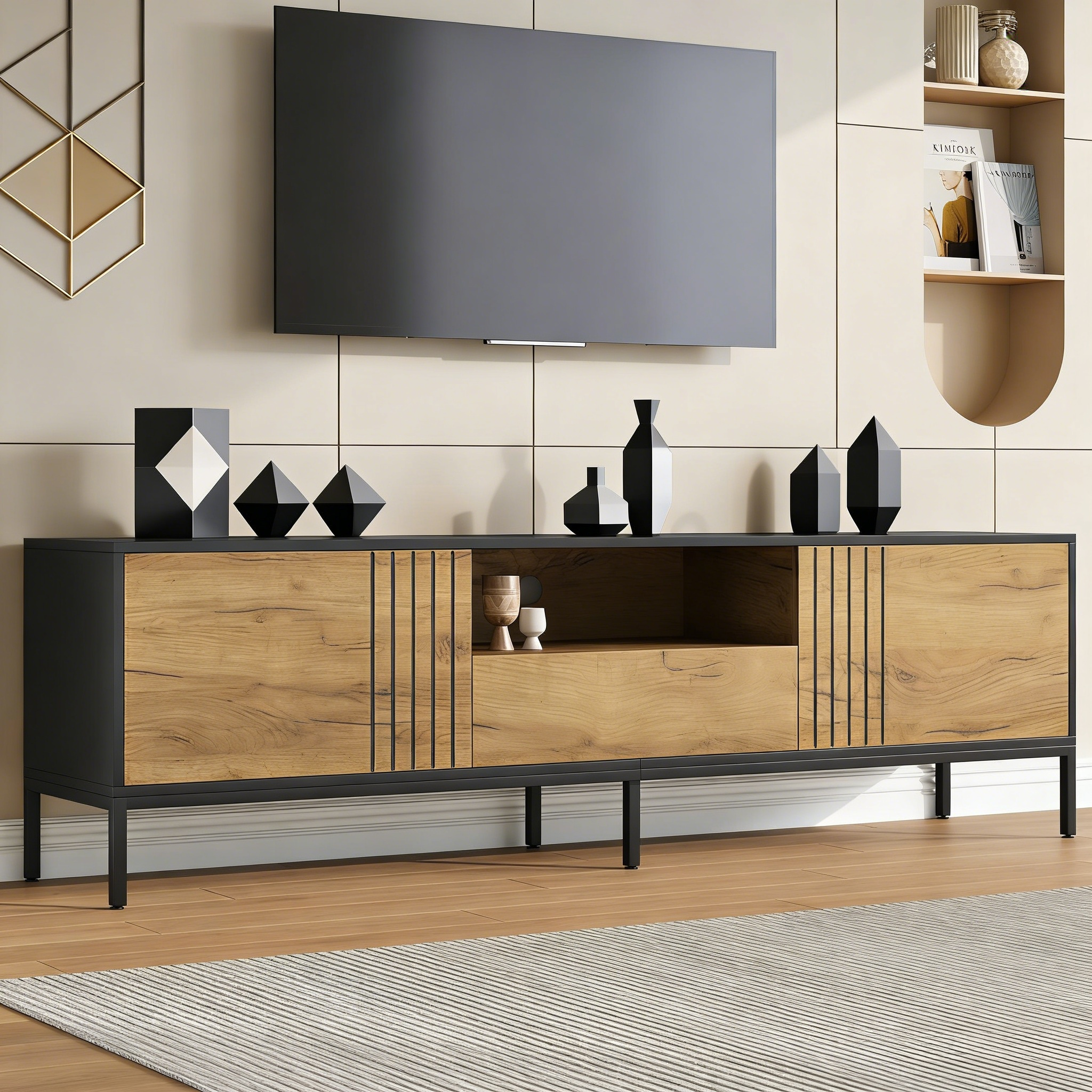

The neatest living room I saw last month was a 3.6 m by 4.1 m Victorian terrace in Bristol with a 180 cm low TV stand, not a floating media console. The wall had old lime plaster, one BS 1363 double socket sat 22 cm above the skirting, and the aerial point came out slightly wonky near the chimney breast. A floating unit would have shown every lump and every cable decision. So here is the thesis: in most UK homes that have not been rewired with hidden sockets, a well-sized TV stand looks cleaner than a floating media console, because it forgives bad walls, hides cables properly and collects dust less visibly.
The case for TV stand
A TV stand is the less glamorous answer, which is partly why it gets unfairly dismissed. The better ones sit low, usually 40-50 cm high, and stretch wider than the screen. For a 55-inch TV, which is about 123 cm wide, I would rather see a 160-180 cm stand than a narrow 120 cm one; the extra width makes the whole wall feel settled rather than top-heavy. A unit like a 170 cm TV unit for larger screens is the sensible scale for many UK living rooms, especially if the telly is 55-65 inches.
The main advantage is not style. It is concealment. A TV stand can swallow the Sky box, router, games console, four-way extension lead and the ugly black power bricks that seem to breed behind every screen. You can cut a 60 mm cable port in the back panel or use an existing one, then keep the mess inside the cabinet rather than pinned to the wall in white trunking. That matters because UK sockets are often low. In rented flats and older terraces, the socket is usually near the skirting, not floating neatly behind the TV. A stand bridges that awkward gap.
Dust is also less annoying than people pretend. Yes, a stand has a top surface, and black glass is a nightmare if you own a shedding dog. But a proper closed-front cabinet means you dust one horizontal plane, not the wall shadow, exposed cable drops and the underside of a floating box. Legs help: 15 cm clearance is enough for most stick vacuums, while 8 cm is the cursed zone where fluff goes to have a kip. Cheap TV stands under £99.99 can look plasticky and bow in the middle; the decent bracket is £180.00-£350.00 for a 170-180 cm unit with doors, cable cut-outs and a 40-50 kg top load. That is still often less than making a floating unit look properly built-in.
The case for floating media console
A floating media console wins the showroom photograph. No legs. No plinth. A clear run of floor underneath. If the wall is flat, the sockets are placed behind the TV or unit, and the screen is also wall-mounted, it can look sharper than any freestanding cabinet. In a Manchester new-build with plasterboard walls, planned electrics and a 2.7 m TV wall, a 140-160 cm floating unit mounted 25-35 cm off the floor can make the room feel wider because your eye sees more floor.
The counterargument to my thesis is strong: floating furniture looks cleaner because it reduces visual weight. That is true in rooms designed for it. If you are renovating and can ask an electrician to put a recessed double socket and aerial point behind the TV, the ugly part disappears. A floating unit then becomes a slim storage line rather than a box parked against the wall. It is also excellent for robot vacuums, which need roughly 9-10 cm clearance and prefer not to fight furniture legs.
The answer is that most people are not starting with a bare stud wall and a friendly electrician. A floating console needs the wall to behave. Plasterboard fixings may quote 25 kg or more, but the real question is where the studs are, often 400 mm or 600 mm apart, and whether the unit’s fixing rail lines up with them. Old brick can crumble. Dot-and-dab walls need the right fixings. A floating cabinet weighing 18 kg, loaded with an 8 kg console, speakers and cables, is not something to hang on optimism after a Sunday trip to the DIY shop. Then there is the cable faff. Surface trunking costs only £8.99-£14.99 for a 2 m length, but it rarely looks invisible. Painted trunking still catches light, especially on a south-facing wall.
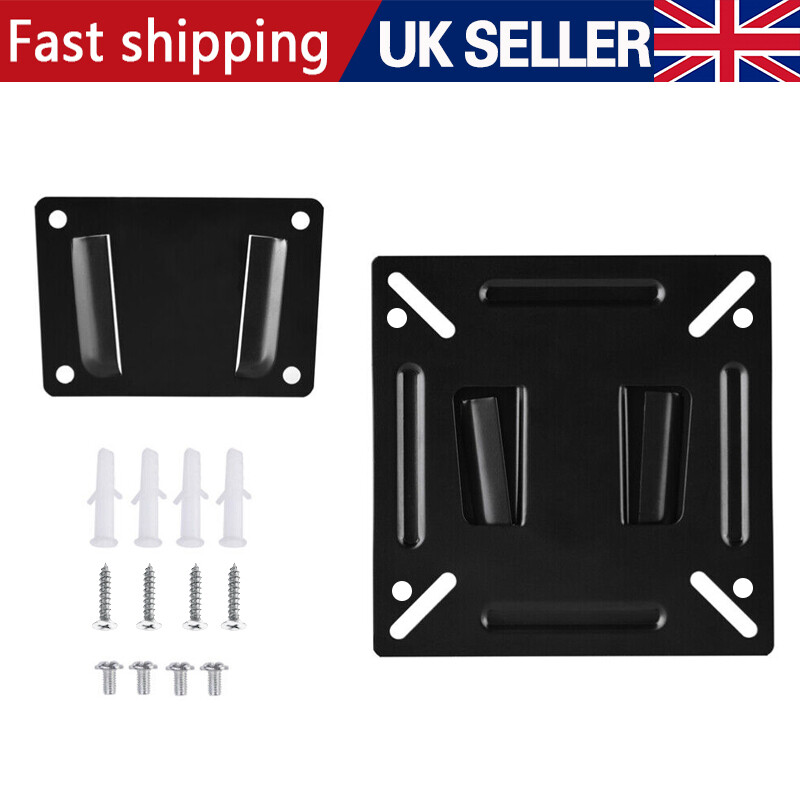
Price is sneakier than the catalogue suggests. A floating unit might be listed at £89.99-£249.99, but the clean version often needs a wall-mounted TV bracket, better fixings, trunking or an electrician. A basic small bracket such as a space-saving wall mount makes sense for compact screens, but larger TVs need a heavier rated mount, and you still need to solve the socket placement. If the wall needs filling and repainting after a failed first attempt, the saving has vanished.
The honest trade-off
A TV stand gives you visual calm by accepting that living rooms contain stuff. It hides the boring equipment, copes with dodgy socket positions and does not ask a tired wall to carry furniture. The cost is floor space: a 180 cm wide, 40 cm deep cabinet takes 0.72 m², which is noticeable in a flat under 55 m². It can also look heavy if the finish is too dark or the unit is taller than 55 cm.
A floating media console gives you a cleaner floor line but pushes the mess upward. The wall has to be good, the fixings have to be right, and the cables have to be planned rather than wished away. If that is all sorted, it looks crisp. If not, it looks like a Pinterest idea interrupted by a broadband router.
A floating console is cleaner only when the wall and wiring are already clean; a TV stand is cleaner in the average UK living room.
This is why the wider living room furniture decision should start with the wall, not the catalogue image. Check where the sockets sit, tap for studs, measure the width of the chimney breast alcove, and look at the room in evening light. That is when trunking, shadows and fingerprints show up.
Which to pick by use case
- Rented flat under 60 m², landlord dislikes drilling: pick a TV stand. You can hide the extension lead and router without arguing about wall damage at checkout. Choose closed doors and a width at least 20 cm wider than the TV.
- New-build with planned sockets behind the screen: pick a floating media console. If the wall is flat, studs are known and cables are already hidden, the clear floor line genuinely looks cleaner.
- Victorian terrace with crumbly plaster and a socket near the skirting: pick a TV stand. A low cabinet will disguise the wall’s sins. A floating unit will frame them.
- Family living room with consoles, remotes and the school-run rush at 8:15: pick a TV stand. Closed storage beats a beautiful floating shelf once controllers, batteries and stray Lego enter the scene.
FAQs
Does a floating TV unit make a small room look bigger?
It can, but only if the cables are hidden and the unit is slim. In a small UK flat with visible trunking down the wall, the floating effect is weakened. A pale, low TV stand can look calmer.
Can I fit a floating media console to plasterboard?
Yes, but do not rely on generic wall plugs. You need to know the unit’s loaded weight, find studs where possible, and use fixings suited to plasterboard or dot-and-dab walls. If in doubt, pay a fitter.
Which option is better for cable management?
A TV stand is usually better unless your sockets and aerial point are already hidden behind the screen or unit. Cabinets with rear cut-outs make routers, consoles and extension leads much easier to disguise.
Which gathers more dust?
A TV stand has a top to dust, but a floating console creates an exposed underside and wall shadow. If you have a robot vacuum, floating wins; if you dust by hand once a week, a closed TV stand is less faff.
How wide should a TV stand or floating unit be?
Aim for the unit to be at least 20-30 cm wider than the TV. For a 55-inch screen, look at 160-180 cm units. For a 65-inch screen, 180 cm usually feels better balanced.
Is a wall-mounted TV required with a floating console?
Not always, but it usually looks cleaner. A TV sitting on top of a floating console adds weight to the fixing job and can look oddly perched unless the unit is deep and rated for the load.